
Designing Training for Frontline Responders
What two EMS trainings taught us about designing for decisions made under pressure
Access Infection Prevention & Control for EMS
Access Pediatric Learning Series
How do you teach infection prevention to someone who has 30 seconds to size up a scene? How do you prepare a paramedic to calm a child in crisis when the usual protocol makes things worse? If you design training for people who work under pressure, these questions are likely familiar. In this article, we discuss how MCD Learn approaches these scenarios with two EMS training series and what we learned along the way.
The Challenge
Frontline responders make decisions fast, with partial information, maybe in cramped and unpredictable settings. They communicate with patients and families in real time, often when standard protocols don't fit the situation in front of them.
Public health topics, like infection prevention and behavioral health, can feel far from that urgency. Long, fact-heavy courses are hard to fit between calls and even harder to recall while in the moment. Training for this work has to be short, relevant, and built around decisions that responders actually make.
What We Built
Infection Prevention and Control for EMS
The Massachusetts Department of Public Health (MDPH) and UMass Memorial Medical Center partnered with MCD Global Health to develop an infection prevention and control curriculum designed specifically for emergency medical services (EMS) professionals.
In the course, responders learn how to:
- Choose precautions from what they can observe before anyone knows the pathogen,
- Protect themselves from when they pick up a patient through hand-off at the hospital, and
- Correctly disinfect the ambulance.
Responding to Pediatric Patients with Behavioral or Intellectual Disabilities
This learning series helps EMS, social service providers, and public safety responders respond to youth with intellectual and developmental disabilities or in mental health crises. The series was developed in partnership with the Maine Center for Disease Control and Prevention (Maine CDC)'s Maternal and Child Health Program and the Maine Pediatric & Behavioral Health Partnership, with subject-matter expertise from Maine EMS.
Participants will learn about:
- Gathering information from caregivers,
- De-escalation,
- Communication and touch, and
- Safe transport.
Infection Prevention and Control for EMS details:
Estimated time:
5 hours
Cost:
Free on infectioncontrolma.org
Format:
Self-paced, four modules, post-test
Continuing education:
Approved for 5.0 CEUs by Massachusetts OEMS
Access Infection Prevention & Control for EMS
Pediatric Learning Series details:
Estimated time:
2.5 hours
Cost:
Free on MCD Learn (sign in or create a free account)
Format:
Self-paced learning series, eight short modules
How We Designed It
Both series used the same four practices:
- Start from the field. We interviewed EMS personnel, patients, and families and walked through real calls and decisions in detail beforehand.
- Keep it short and modular. Modules run from 20 to 30 minutes, so responders can finish between tasks, and each makes sense on its own.
- Practice the decision. Branching scenarios give consequence-based feedback, so learners gather information, choose, and see what happens next.
- Test, then hand off. Subject-matter experts reviewed the content, and EMS personnel pilot tested it. Partner agencies now host the training, promote it, and award credit, so it remains available even after development is complete.
Sneak Peek Inside Module 4: A Week of Calls
The last module of the infection prevention series is a game. Learners work 10 calls over five shifts from a febrile traveler to a nursing home outbreak. On each call they read the scene, choose the syndrome and likely pathogens, and select precautions and personal protection equipment. Harder calls add a timer, transport, hand-off communication, and disinfection.
After each call, learners will see their score for every step and an explanation of the right answer. Low scores raise the odds that someone on the crew gets sick and misses shifts. Learners practice making the call with stakes included that they recognize.
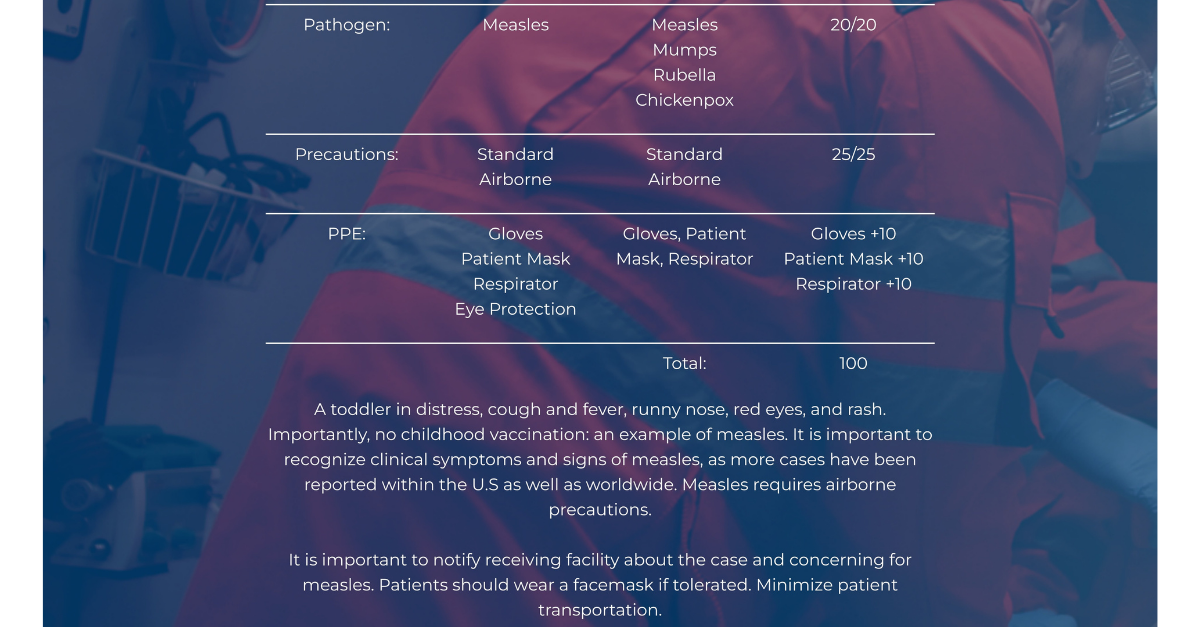
Above: In one call, an unvaccinated toddler who recently traveled overseas has a fever, cough, red eyes, and a rash. The results screen explains why this points to measles and airborne precautions.
What We Found
In the infection prevention series (November 2024 to October 2026):
- 329 learners started the training, with 71% working in EMS; the remaining participants included nurses and infection preventionists.
- Average test scores rose from 49% to 76% from pre-test to post-test, and 92% of learners improved.
- 96% of module evaluations said learners' knowledge grew: "It helped put the knowledge I learned into real possible scenarios," and "Learned that I wasn't changing gloves enough."
What We Learned
- Put the details in a job aid. Learners asked for printable reference sheets. Agreeing with experts on what learners must act on and moving the rest to a reference cuts cognitive load.
- Scenarios are what stick. They drew the most praise in open-ended feedback.
- Explain the "Why?" Learners wanted to know why an answer was wrong, and all-or-nothing scoring frustrated them.
- Built to hand off. When partners host, credit, and promote a training, it keeps reaching people.
Bring This Approach to Your Work
The same approach fits other roles that make fast calls with incomplete information: dispatchers, law enforcement, community health workers, and other frontline and community-based staff.
MCD Learn designs and hosts eLearning for health departments, health systems, and community organizations. If you're planning training for a workforce like this, we'd love to talk.
Featured at APHA 2026
This topic will be presented at the American Public Health Association (APHA)’s 2026 Annual Conference by Hannah Huggins, MCD Learn program manager. from 5–6 p.m. Sunday, November 1, in the Exhibit Hall 3–4, Board 5.
View Session Information and Abstract
Developed in partnership with:
- Massachusetts Department of Public Health
- UMass Memorial Medical Center
- Maine CDC’s Maternal and Child Health Program
- Maine Pediatric & Behavioral Health Partnership
- Maine EMS
The Infection Prevention and Control for EMS training was funded by the Massachusetts Department of Public Health through a subrecipient grant supported by the Centers for Disease Control and Prevention's Epidemiology and Laboratory Capacity for Prevention and Control of Emerging Infectious Diseases (ELC) Cooperative Agreement CK19-1904 (Infection Prevention and Control Supplement).
The Responding to Pediatric Patients with Behavioral or Intellectual Differences Learning Series was supported by the Health Resources and Services Administration (HRSA) of the U.S. Department of Health and Human Services (HHS), through the Pediatric Mental Health Access Grant. The contents are those of the author(s) and do not necessarily represent the official views of HRSA, HHS, or the U.S. Government.